

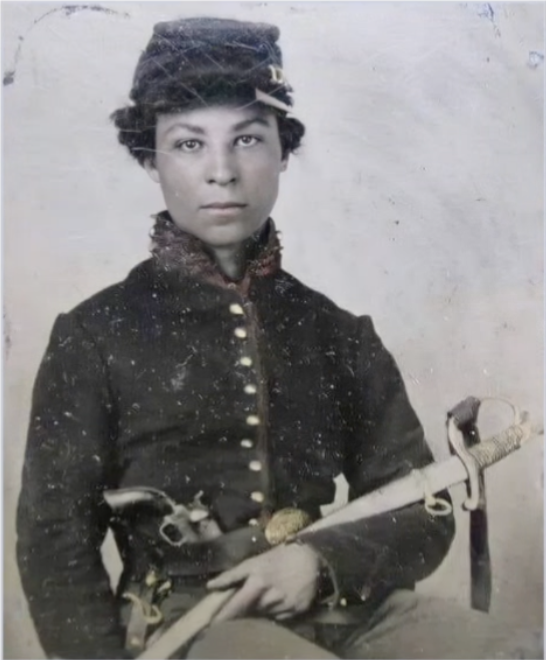
At a time when women were prohibited from serving in the U.S. Army, Cathay Williams refused to let the rules determine her future. Born into slavery, she disguised herself as a man and enlisted under the name William Cathay, becoming the only known and documented woman to serve as a Buffalo Soldier.
Her extraordinary story will be featured in the Great Plains Black History Museum’s upcoming Buffalo Soldiers exhibit, opening Oct. 1.
Williams was born in September 1844 in Independence, Missouri, to a free father and an enslaved mother. Under the laws of the time, she inherited her mother’s status and was legally enslaved.
As a young woman, Williams worked on a plantation near Jefferson City. When Union forces occupied the city in 1861, she was classified as “contraband”, the term the military used for formerly enslaved people who came under Union control, and was assigned to support the Army.
Eric Ewing, the executive director of the Great Plains Black History Museum, said she was 17 years old when she served as a cook and laundress while accompanying Union troops. Her experiences reportedly included traveling with Gen. Philip Sheridan’s forces and witnessing major Civil War campaigns, including the Red River Campaign, the Siege of Vicksburg, and Sherman’s March to the Sea.
Those years exposed Williams to military life and may have influenced the decision that would later secure her place in American history.
Following the Civil War, Williams faced extremely limited employment opportunities as a newly freed Black woman. In November 1866, she enlisted in the U.S. Regular Army under the name William Cathay and committed to a three-year term.
Because the Army did not require full medical examinations at the time, Williams was able to enlist and continue serving while presenting herself as a man.
She was assigned to the 38th U.S. Infantry Regiment, one of the first all-Black infantry regiments created after the Civil War. These Black military units became collectively known as the Buffalo Soldiers.
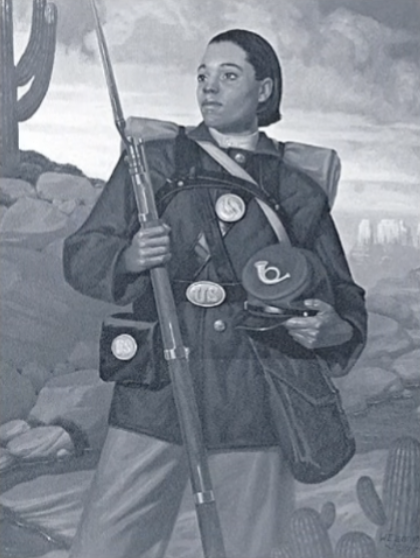
Williams served in New Mexico, where her regiment helped protect travel routes and supported work connected to the nation’s westward expansion. She contracted smallpox and experienced recurring health problems that led to frequent hospitalizations.
During one of those examinations, an Army surgeon discovered her identity. Williams was honorably discharged in 1868 after serving for nearly two years.
Williams continued building a life for herself after leaving the military. She worked as a cook at Fort Union, New Mexico, before moving to Pueblo, Colorado. She later settled in Trinidad, Colorado, where she worked as a seamstress.
Her military service became publicly known in 1876 when a St. Louis newspaper published her account. Williams later applied for a military disability pension, but despite her declining health and documented service, the federal government denied her claim.
Her story challenges traditional ideas about who served, survived, and helped shape the American West. The National Endowment for the Humanities recounts Williams’ pursuit of independence and opportunity despite the restrictions placed on her because of her race and gender.
Fascinated with Buffalo Soldiers and Williams’ story, Ewing designed the exhibit, organizing the history into six double-sided banners. The display will also include documents, photographs, and other interpretive materials.
“There are six banners telling the history of the Buffalo Soldiers,” Ewing said. “The research took me quite a while, but putting it together on the banners took probably a couple of days.”
Visitors will learn about Williams, the 9th and 10th Cavalry, the Buffalo Soldiers stationed at Fort Robinson, Lt. Henry O. Flipper, and others whose stories have frequently been left out of traditional accounts of American history. The exhibit will also explore unexpected connections between the Buffalo Soldiers, conservation, and Smokey Bear.
For Ewing, creating an exhibit involves more than collecting historical facts. It means helping Nebraskans understand that Black history did not simply happen somewhere else.
It happened here.
Plan your visit
The History of the Buffalo Soldiers will be displayed from Oct. 1, 2026, through Jan. 2, 2027, at the Great Plains Black History Museum, 2221 N. 24th St. in Omaha.
The museum is open Wednesday through Saturday from 1 to 5 p.m. Admission is free, and donations are encouraged.
Visit the Great Plains Black History Museum to learn more about the exhibit, upcoming programs, and ways to support the museum.