

Mari Sandoz and the Stories of the Great Plains
The Nebraska Sandhills stretches wide and quiet, a landscape that can feel as if it keeps its own stories.
Born May 11, 1896, near Hay Springs, Nebraska, Sandoz grew up in a homesteading family on the plains. Her father, Jules Ami Sandoz, was a Swiss immigrant whose life and influence would later become the subject of one of her most well-known works. Her relationship with her father was complex and often difficult, a dynamic that would later shape the tone and honesty of her writing. Sandoz’s early years were marked by the demands of frontier life, including farm labor and limited access to formal education.
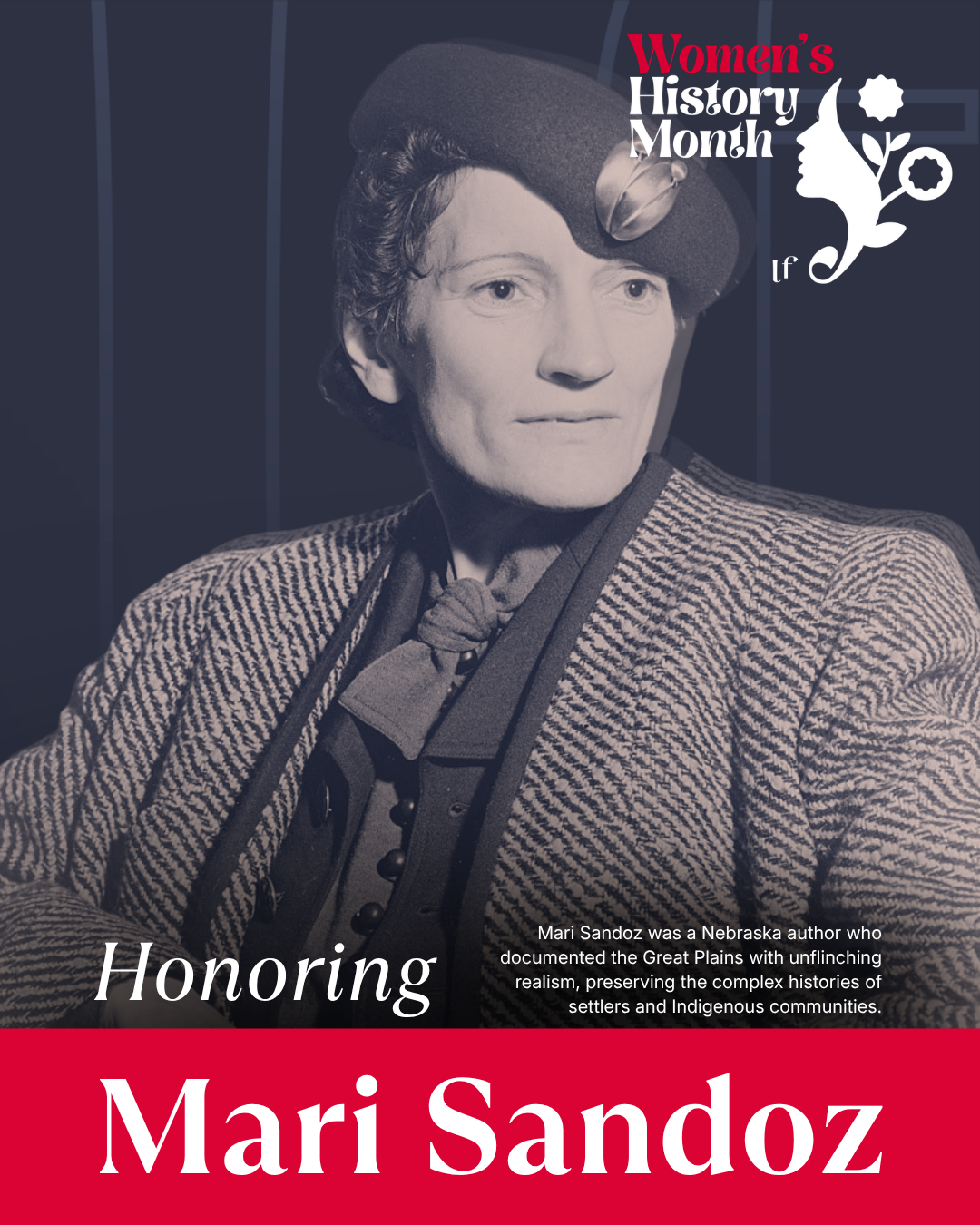
She did not achieve literary success until her 30s.
After attending the University of Nebraska–Lincoln, though never earning a degree, Sandoz turned to writing with a focus on the people and histories of the Great Plains. Without a formal college degree, she built her career through self-education, research, and persistence alongside her non-traditional academic experience. Her work drew from oral histories, firsthand accounts and extensive research, often centering Indigenous communities and frontier experiences that had been overlooked or simplified in mainstream narratives.
Her 1935 biography, Old Jules, based on the life of her father, brought her national attention after winning the nonfiction prize in The Atlantic Monthly contest. The manuscript was rejected multiple times before it was finally accepted, reflecting both the difficulty of the subject matter and Sandoz’s refusal to soften its portrayal. The book was noted for its unvarnished portrayal of homesteading life and its departure from romanticized depictions of the American West.
Sandoz continued to build a body of work that blended historical research with narrative storytelling. Among her most recognized books is Crazy Horse: The Strange Man of the Oglalas (1942), a biography of the Lakota leader. The work drew on interviews with Oglala Lakota sources and became one of the early widely read accounts to rely extensively on Indigenous testimony and Plains cultural knowledge, though it has also been revisited and critiqued by later scholars.
Her broader writing includes both nonfiction and fiction, with titles such as Cheyenne Autumn (1953), which recounts the Northern Cheyenne’s attempt to return to their homeland after forced relocation, and The Buffalo Hunters (1954), which examines the economic and environmental forces that shaped the plains.
Throughout her career, Sandoz focused on documenting the complexities of the region, its violence, resilience and cultural intersections, rather than presenting a singular or romantic narrative.
Much of her research process relied on building relationships with community members, gathering oral histories and cross-referencing accounts, an approach that contributed to the depth of her work but also reflected the challenges of interpreting histories across cultures.
Sandoz spent much of her later life in New York City while continuing to write about Nebraska and the Great Plains. She died March 10, 1966, leaving behind a body of work that remains central to the region’s literary and historical record.
In 1950, the University of Nebraska-Lincoln awarded her an honorary Doctor of Literature degree, recognizing the work she had accomplished without a formal academic credential.
Today, her legacy is reflected in continued scholarship, preservation efforts and institutions such as the Mari Sandoz High Plains Heritage Center in Chadron, Nebraska, which works to share the stories she documented.
Her writing did not attempt to simplify the plains.
Instead, it insisted that the stories held there, of settlers, of Indigenous nations, of conflict and survival, be told with detail, complexity and care.
