

Anna Wilson: Omaha’s Unlikely Philanthropist
Anna Wilson built her fortune in Omaha’s Sporting District, then quietly redirected it toward the city’s most vulnerable.
Much of Anna Wilson’s early life remains uncertain, a reflection of both the time she lived in and the life she would go on to lead. She is widely believed to have been born in Georgia around 1835 to English immigrant parents, with some accounts suggesting her father was a Baptist minister. Still, historians note that details about her upbringing are not fully confirmed.
What is clearer is that Wilson arrived in Omaha around 1867 with her partner, Dan Allen, at a time when the city was rapidly growing alongside the railroad. Omaha’s Sporting District along Douglas Street had become one of the most active vice districts in the region, filled with brothels, gambling houses, and saloons that catered to railroad workers, travelers, and businessmen moving through the city.
By the 1870s, Wilson was living on Douglas Street, first listed in the federal census as “keeping house.” In reality, she was working within the vice economy connected to Allen, a well-known gambler and saloon keeper. After Allen’s death in 1884, Wilson inherited a substantial sum and stepped fully into her own as an independent businesswoman.
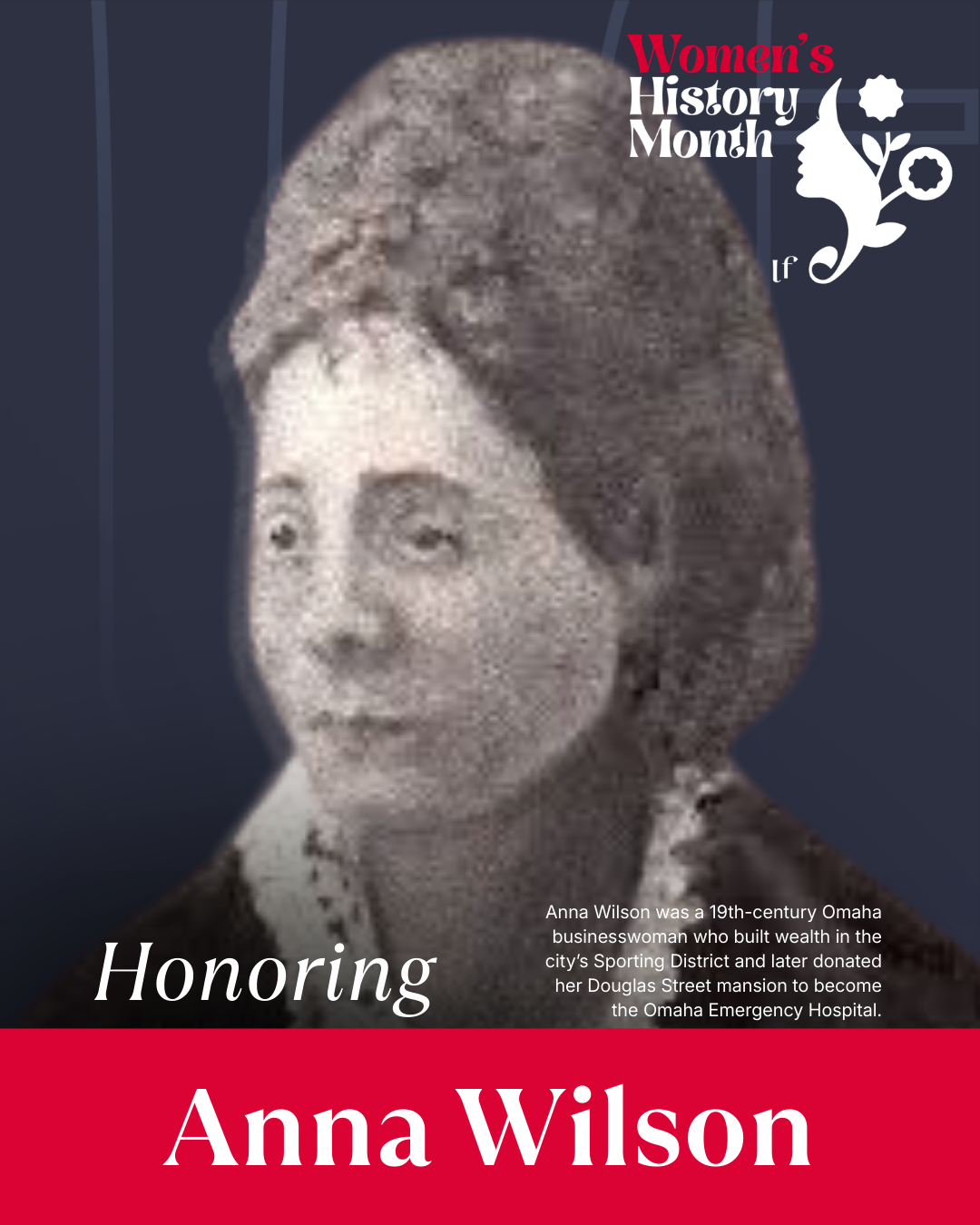
In 1886, she constructed a three-story, 25-room mansion at 912 Douglas St. The ornate building, decorated with provocative artwork, operated as a high-end brothel for more than 25 years. At one point, she housed about 10 women between the ages of 18 and 30, offering them not only wages but medical care and support, an uncommon practice at the time.
Wilson ran the establishment for more than two decades before retiring from the business in 1896. By then, she had already begun expanding her wealth through real estate and investments, building a level of financial independence that was rare for women of her era.
In 1906, she moved into a large mansion at 2018 Wirt Street in the Kountze Place neighborhood, one of Omaha’s most prestigious residential areas at the time. The move marked a transition in both geography and legacy, from the Sporting District to one of the city’s most prominent neighborhoods.
Over the decades, Wilson accumulated significant real estate holdings and quietly became one of Omaha’s notable philanthropists. Her contributions supported organizations such as the Child Saving Institute, Clarkson Hospital, the Creche Home for Children, the city mission, and Prospect Hill Cemetery, where she and Allen were buried. She also left her Wirt Street mansion to the Old People’s Home Association, along with funds to maintain it. Some historical accounts estimate that Wilson directed more than $1 million in charitable giving through her estate and property donations, a remarkable sum for the time.
Her most widely known gift, however, came through her Douglas Street mansion. In the years leading up to her death in 1911, Wilson arranged for the property to be used by the City of Omaha as a hospital. Initially hesitant, the city agreed to lease the building for $125 a month until her death. It went on to become the Omaha Emergency Hospital, later serving as a communicable-disease treatment center for years before the building was ultimately sold and razed in 1946.
Notably, the city chose not to name the hospital after her, instead calling it simply City Emergency Hospital.
Today, Anna Wilson’s story remains part of Omaha’s layered and often complicated history. Her life reflects both the realities of survival and entrepreneurship in a rapidly growing frontier city and the profound impact of quiet philanthropy. Her legacy continues to echo in modern Omaha, with places like Wilson & Washburn restaurant and Anna’s Place speakeasy at Hotel Indigo drawing inspiration from her story, reminders that history is rarely simple, and the impact can come from the most unexpected places.
