

Willa Cather: How a Nebraska Storyteller Shaped American Lit
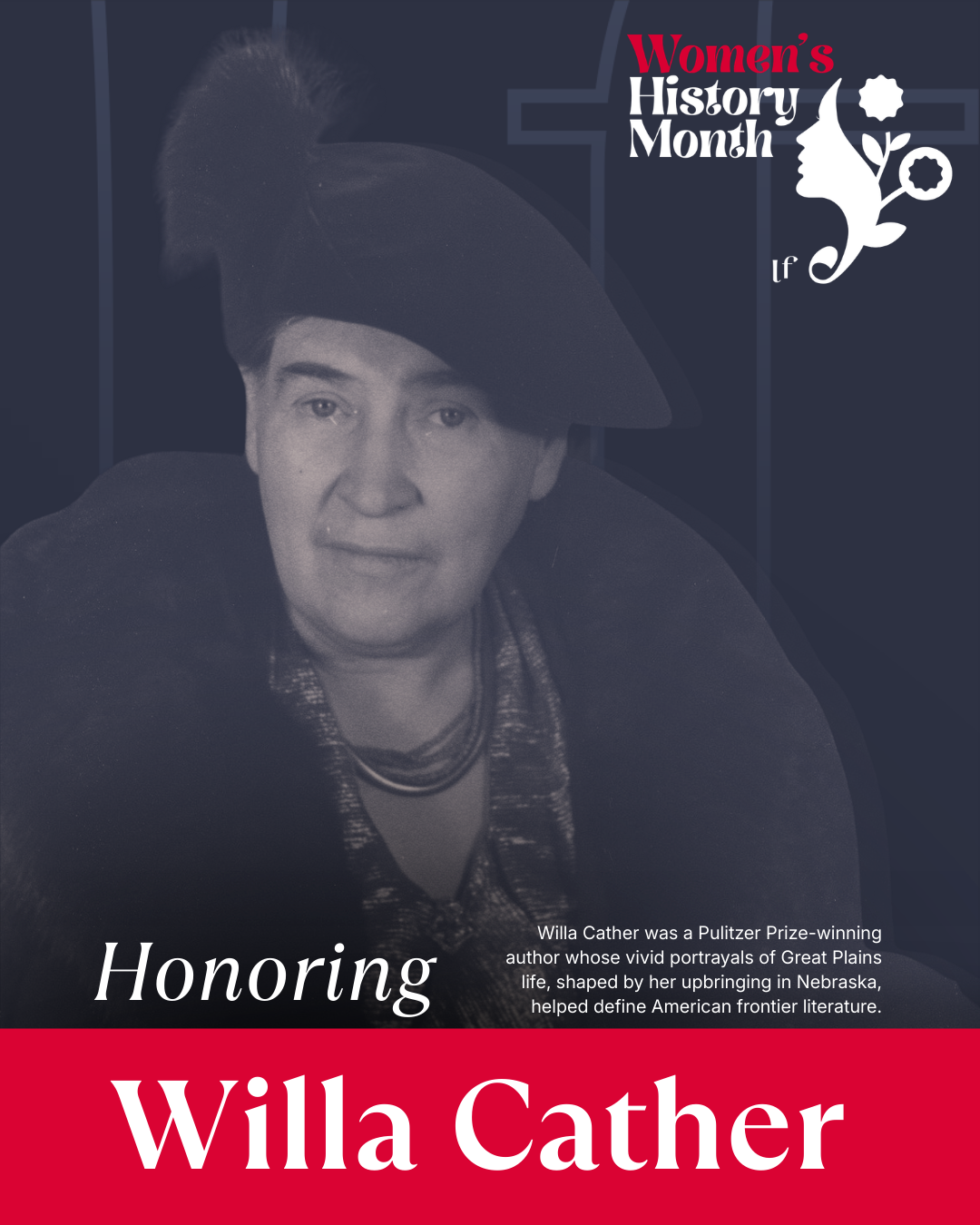
Before the prairie was romanticized in American literature, Willa Cather wrote it as she knew it. Wide. Wind-swept. Honest.
Born Wilella Sibert Cather on Dec. 7, 1873, in Virginia, she moved with her family to Webster County, Nebraska, at age 9. They later settled in Red Cloud, a frontier town shaped by homesteaders and immigrants chasing possibilities. That landscape, both harsh and hopeful, would become the heartbeat of her fiction.
After graduating from Red Cloud High School in 1890, Cather enrolled at the University of Nebraska in Lincoln. During her first year, an essay she wrote on Thomas Carlyle was published in the Nebraska State Journal without her knowledge. Seeing her words in print changed her. She began writing columns for the paper, earning a dollar each and discovering what she later described as the hypnotic pull of publication. She became managing editor of The Hesperian, the university’s student newspaper, and contributed to the Lincoln Courier.
Interestingly, she legally changed her name to Willa as a teenager.
After college, Cather moved to Pittsburgh, where she worked as a magazine editor and high school English teacher for a decade before turning fully to fiction. Of note, she moved to New York City in 1906, and worked at McClure's Magazine.
She would go on to write enduring novels of the Great Plains, including “O Pioneers!,”“The Song of the Lark” and “My Ántonia.” Her work and widely acclaimed masterpiece explored immigration, exile, nostalgia and the intimate relationship between people and place.
In 1923, she won the Pulitzer Prize for “One of Ours,” set during World War I. She was awarded the French Legion of Honor in 1930.She was the first woman to receive an honorary degree from Princeton University on June 1931.
Cather died in 1947, but Nebraska never stopped claiming her. The Willa Cather Foundation site in Red Cloud was designated a national historic landmark in 1971. From the Nebraska Hall of Fame to a 2023 bronze statue in the U.S. Capitol’s National Statuary Hall, her legacy stands tall.
A glance at her many writings
Novel publication years
1) Alexander's Bridge (1912)
2) O Pioneers (1913)
3) The Song of the Lark (1915)
4) My Antonia (1918)
5) One of Ours (1922)
6) A Lost Lady (1923)
7) The Professor's House (1925)
8) My Mortal Enemy (1926)
9) Death Comes for the Archbishop (1927)
10) Shadows on the Rock (1931)
11) Lucy Gayheart (1935)
12) Sapphira and the Slave Girl (1940)
Short Fiction Collections
1) The Troll Garden (1905)
2) Youth and the Bright Medusa (1920)
3) Obscure Destinies (1932)
4) The Old Beauty and Others (1948)
Poetry Collections
1) April Twilights (1903)
2) April Twilights and Other Poems (1923)
Non-Fiction
1) My Autobiography by S. S. McClure (1914)
2) Not Under Forty (1936)
3) Willa Cather on Writing (1949)