

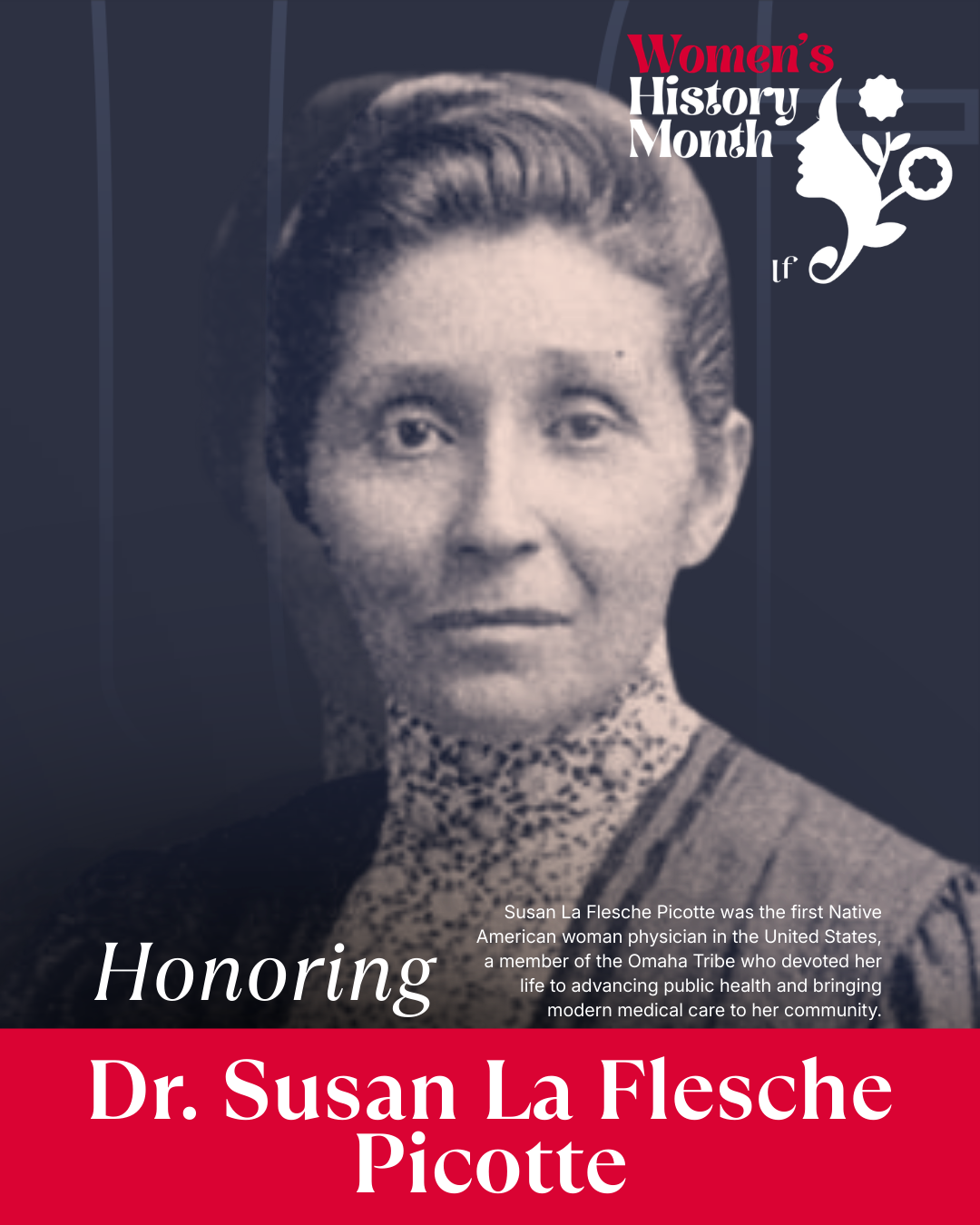
Dr. Susan La Flesche Picotte: First Native American Woman Physician and Public Health Pioneer
On the Omaha Reservation in the late 19th century, access to medical care was often a matter of life or death. As a child, Susan La Flesche witnessed a Native woman die after a white doctor refused to treat her. The injustice of that moment stayed with her. It became her calling.
Born June 17, 1865, Susan La Flesche was a member of the Omaha Tribe and daughter of Joseph La Flesche, known as Iron Eye, the last recognized chief of the Omaha Tribe and a strong advocate for education and cultural adaptation. His belief in the power of learning deeply shaped Susan’s worldview.
She began her education at the mission school on the Omaha reservation, first run by Presbyterians and later by Quakers under President Ulysses S. Grant’s Peace Policy. Her academic promise soon carried her beyond Nebraska. She continued her studies in Elizabeth, New Jersey, and later attended Hampton Institute in Virginia, an institution founded to educate formerly enslaved students and later Native students.
Fluent in English, Omaha, French, and Otoe, La Flesche moved comfortably across cultures, an ability that would become essential in her life’s work.
In 1886, at a time when most medical schools did not admit women, she was accepted to the Woman’s Medical College of Pennsylvania. Her academic excellence quickly stood out. She completed the demanding three-year medical program in just two years and graduated valedictorian of her class in 1889.
With that achievement, she became the first Native American woman physician in the United States and one of the first Indigenous people to earn a medical degree.
She married Henry Picotte in 1894, and the couple had two sons.
Dr. Susan La Flesche Picotte returned home to serve the Omaha people. She worked as a physician at the government boarding school on the reservation but quickly expanded her reach far beyond that role. Traveling miles across rural Nebraska, often by horse and buggy, she treated patients in their homes and surrounding communities.
Her work went beyond individual care. She championed public health education, promoted sanitation and hygiene practices, fought tuberculosis through community awareness, and supported the temperance movement in an effort to reduce alcohol-related harm in Native communities. She also helped Omaha citizens navigate the federal bureaucracy, advocating for tribal members to receive funds owed to them from land sales through the Office of Indian Affairs.
Her leadership extended into broader civic and medical spaces as well. In the early 1900s, she served as chair of the State Health Committee of the Nebraska Federation of Women’s Clubs, joined the Walthill health board in 1907, and helped establish the Thurston County Medical Society that same year.
One of her most significant achievements came in 1913 when she opened a hospital in Walthill, Nebraska, after years of campaigning to bring modern healthcare to the reservation.
The hospital was groundbreaking for its time. It was the first modern hospital in Thurston County, privately funded, and served both Native and non-Native patients. More than a building, it represented La Flesche Picotte’s belief that her community deserved access to the same level of care available elsewhere.
Today, the Dr. Susan La Flesche Picotte Memorial Hospital stands as a National Historic Landmark. She died in 1915, at the age of 50.
Her legacy lives on in Nebraska and far beyond it, in schools, monuments, stories, and the hospital she fought to build. But most powerfully, it lives in the generations of Naive physicians, leaders, and advocates who continued the work she began: breaking barriers and caring for communities that once had nowhere else to turn.
