

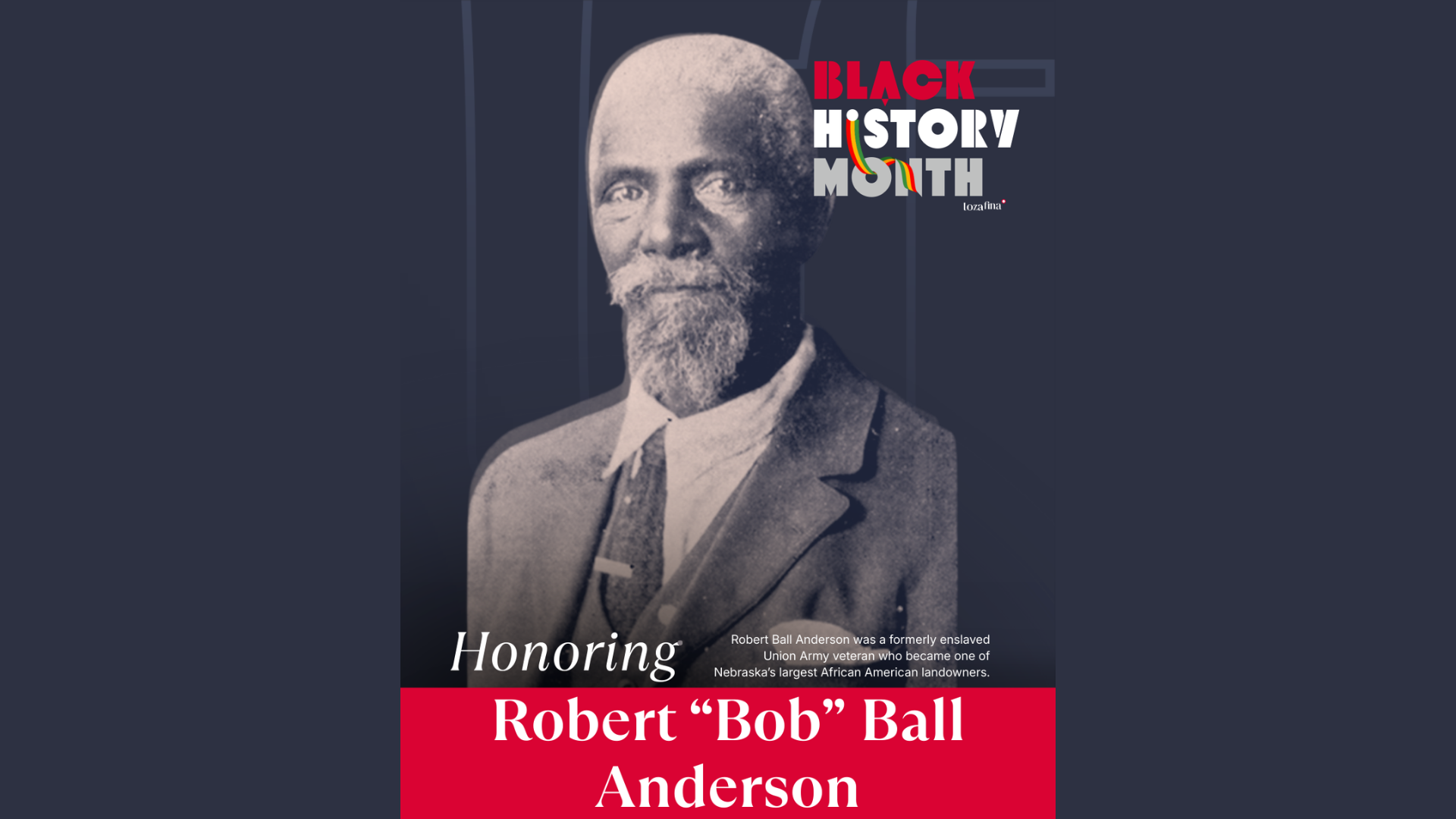
Robert Ball Anderson
Legacy Maker | Land, Freedom, and Self-Determination
Story by Aniya Porter
Robert “Bob” Ball Anderson’s life tells a powerful American story of survival, service, and an unyielding pursuit of freedom through land ownership. Born into slavery on March 1, 1843, Anderson came of age in a nation divided. During the U.S. Civil War, he served in the Union Army, fighting for a freedom he would later claim in his own way: by owning land.
Shortly after the war, he and his siblings adopted the surname Anderson and briefly returned to the plantation where they had been enslaved. Finding the conditions unstable and limiting, he moved on, first to Iowa, and then west, drawn by the promise of the Homestead Acts and the possibility of independence. With little more than determination, he was said to have purchased an ox team and paid his way to Nebraska by freighting goods, arriving ready to build a life on his own terms.
In Butler County, Anderson acquired homestead land and set to work farming. But the land tested him. The Panic of 1873 depressed farm prices; drought and years of grasshopper infestations devastated crops. Anderson persisted longer than many of his neighbors, but by 1881, economic and environmental pressures forced him to give up the land.
Rather than surrender the dream, Anderson regrouped. He moved to Kansas, received his only formal education, saved his wages, and prepared for a second chance. That chance came in 1884, when he homesteaded again, this time in western Nebraska, later known as Box Butte County. One of the area’s first African American settlers, he lived in a dugout and survived largely on wild game, slowly building a viable farming operation.
Through discipline and foresight, Anderson expanded his holdings, purchasing land from neighbors who moved away. By 1902, he owned more than 1,400 acres; by 1910, he was Nebraska’s largest African American landowner. At his peak, Anderson owned over 2,000 acres.
Robert “Bob” Ball Anderson’s legacy endures as a testament to resilience and self-determination, proof that freedom is not only won, but built, acre by acre.
Know a Black community leader whose story should be told? Nominate them by emailing office@lozafina.com.
