

Preston Love Sr.: The Sound of North Omaha’s Golden Era
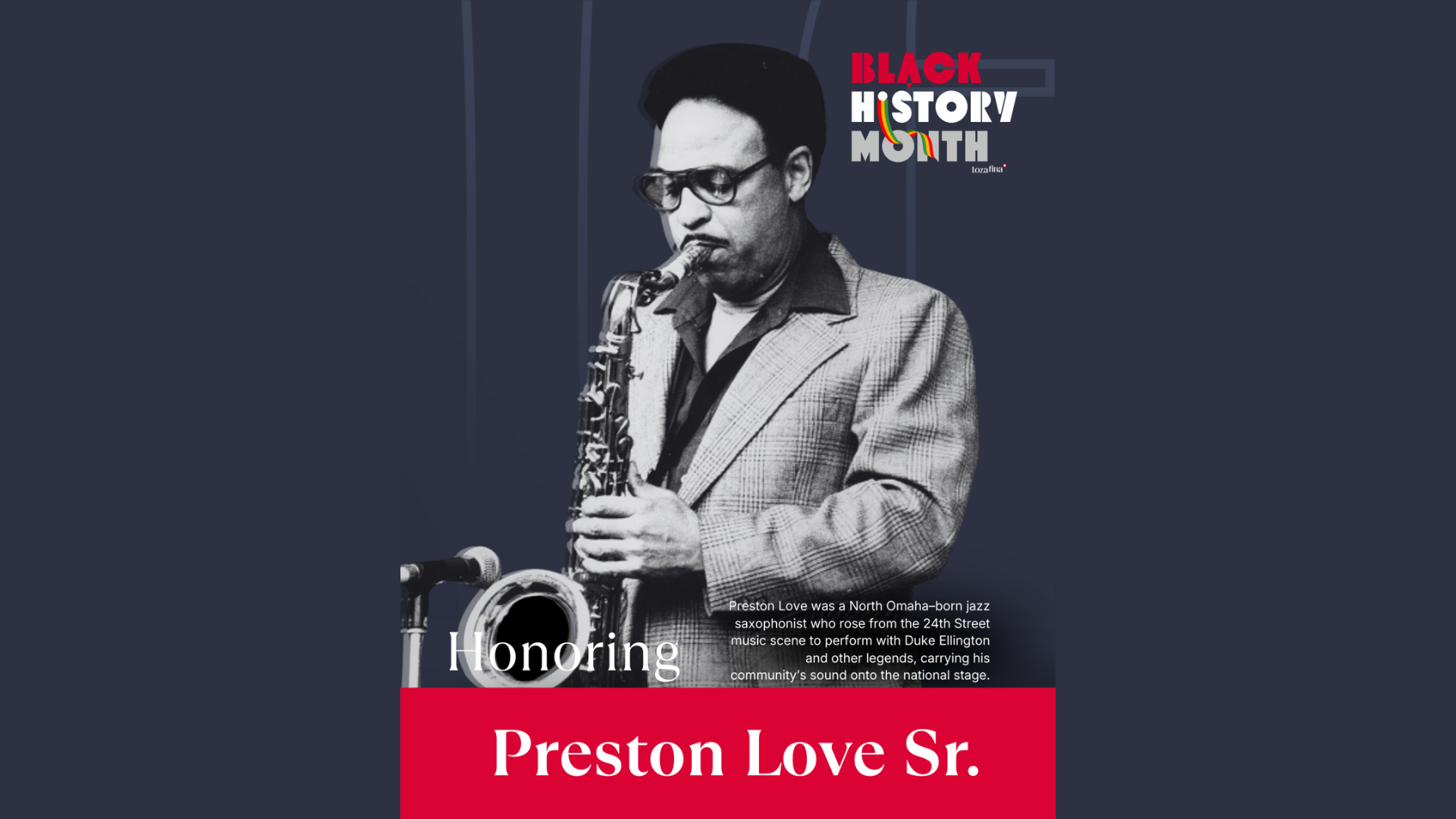
Preston Love Sr.
Legacy Maker | Black Musical Excellence
Story by Aniya Porter
In the mid-20th century, when North Omaha pulsed with the sound of live jazz pouring from clubs along 24th Street, a young saxophonist named Preston Love Sr. was developing the tone and tenacity that would carry him far beyond Nebraska.
Born in 1921, Love came of age in a segregated Omaha where opportunity for Black musicians was often limited to the city’s own entertainment corridor. Yet North Omaha was not culturally isolated. Anchored by venues such as the historic Dreamland Ballroom, the neighborhood attracted nationally touring acts and cultivated a generation of local talent. Love emerged from that scene as one of its most promising young performers.
By the 1940s, his musicianship had earned him a place in the orchestra of legendary bandleader Duke Ellington, one of the most respected ensembles in American music. Performing with Ellington positioned Love within a defining chapter of jazz history, placing a North Omaha native on stages across the country during a transformative era for Black artistry.
Love’s career extended well beyond his time with Ellington. Over the decades, he performed and recorded with prominent artists including Count Basie, Ray Charles, Lena Horne, and Aretha Franklin. His work traversed jazz, rhythm and blues, and early rock and roll, reflecting the evolution of American popular music across the 20th century.
Yet Love’s significance cannot be measured solely by the prominence of his collaborators. For North Omaha, he became a living testament to the neighborhood’s cultural depth. At a time when systemic racism constrained economic and social mobility, his national career served as evidence that world-class excellence could emerge from a community often overlooked or mischaracterized.
Historians of Omaha’s Near North Side note that the area once rivaled larger Midwestern cities as a regional jazz hub. Urban renewal projects and highway construction in the latter half of the century disrupted much of that corridor, closing venues and displacing residents. In that context, Love’s legacy took on additional meaning. His career preserved a connection to an era when North 24th Street was synonymous with nightlife, artistry, and Black enterprise.
Love continued performing well into his later years, maintaining ties to Omaha even as his reputation extended nationally. When he died in 2004, he left behind not only recordings and tour credits, but a historical throughline linking North Omaha’s golden jazz era to contemporary conversations about cultural preservation.
Today, as Black History Month invites reflection on local and national figures alike, Preston Love Sr. stands as both musician and marker, a reminder that the story of American jazz includes North Omaha, and that its rhythm was shaped in part by a saxophonist who carried his community’s sound onto the world stage.
Know a Black community leader whose story should be told? Nominate them by emailing office@lozafina.com.
