

The Long Work of Mental Health Advocacy: Annette Dubas’ Story
Celebrating Asian American & Pacific Islander Heritage Month
Story by Hamza Noor
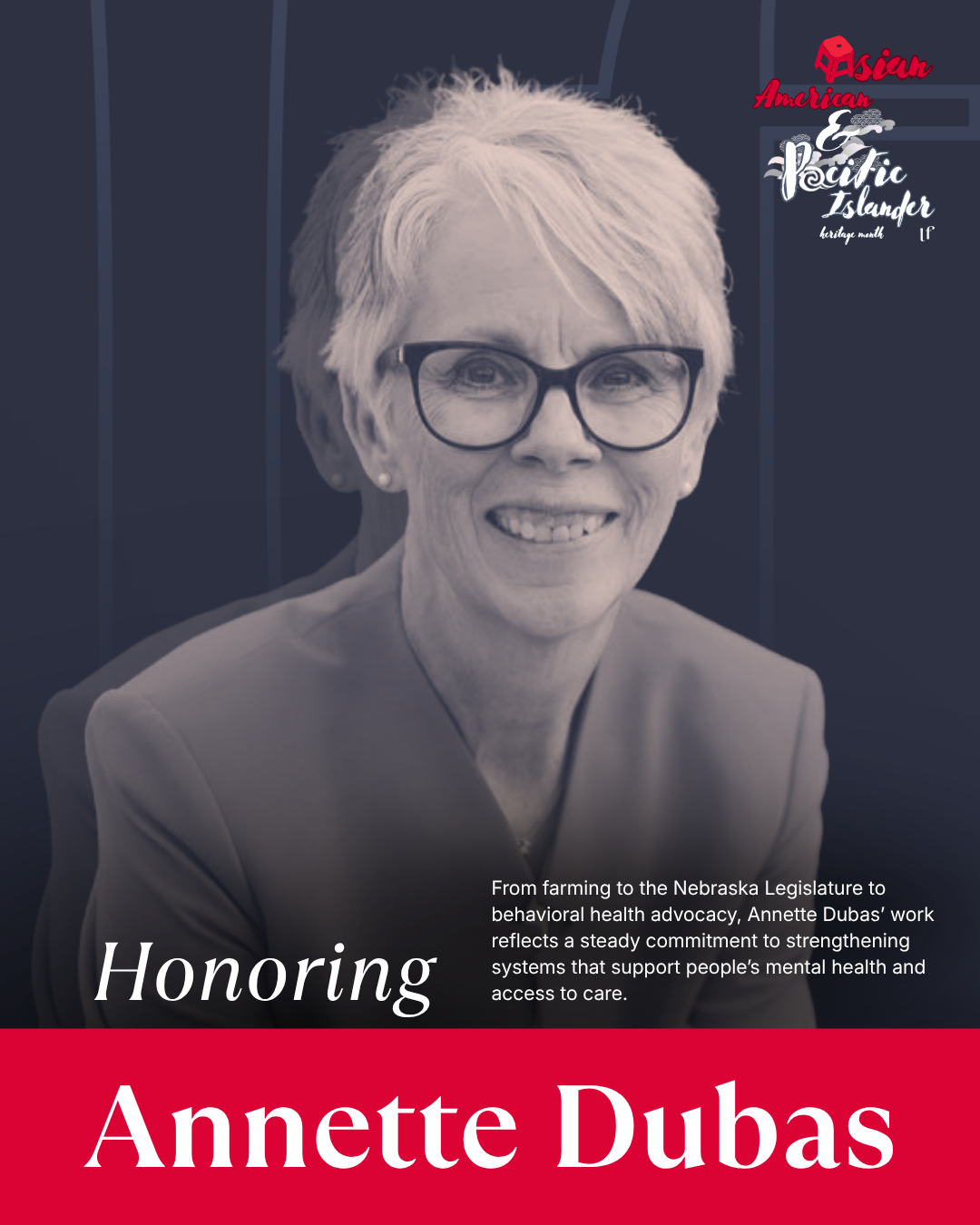
In Nebraska, conversations about mental health don’t start in conference rooms. They start in places like kitchens, schools, and farms, where people are quietly trying to figure out what to do next. Annette Dubas understands that because she’s lived it. As a Nebraskan with Filipino heritage, her understanding of community, resilience, and care has long shaped how she approaches public service. Before she ever stepped into public office, she was working as a farmer and rancher, rooted in a way of life that doesn’t allow you to look away from problems. You deal with what’s in front of you, and that mindset followed her into the Nebraska Legislature, where she represented District 34 from 2007 to 2015.
Mental health wasn’t the plan, but it became the work. During her time in the Legislature, Dubas found herself pulled into behavioral health issues, eventually making it one of her focus areas. It wasn’t theoretical. It was urgent, layered, and often misunderstood. Like many who stay in this space, she didn’t stay because it was easy. She stayed because she could see the gaps and the people falling through them. That experience shaped how she understood policy, not as something abstract, but as something that either works for people or doesn’t.
When her term ended, Dubas expected to return to the farm full-time. But stepping away didn’t sit right. After years of building relationships, understanding systems, and seeing where things were breaking down, she knew she still had something to offer. That’s when she became the first executive director of the Nebraska Association of Behavioral Health Organizations, stepping into a role that didn’t come with a clear blueprint. At the time, the organization had just over 40 members. Today, it has grown to around 60, representing a wide range of providers across the state, from large hospital systems to smaller community-based organizations. That growth reflects more than numbers. It points to the trust she’s built and the steady work of helping organizations move in the same direction, even when their day-to-day realities look very different.
Dubas has spent more than a decade focusing on one core challenge: making sure behavioral health providers can sustain their work so people can access care. Much of that comes down to funding structures and reimbursement rates, issues that aren’t always visible to the public but sit at the center of whether services exist at all. Her approach has been practical and consistent, grounded in the understanding that if providers can’t keep their doors open, access disappears, no matter how strong the intent behind a policy might be. At the same time, her work has extended beyond funding. She has helped build connections across sectors, linking behavioral health to schools, corrections, workforce development, and the broader economy. In Nebraska, where the needs of urban and rural communities can look different on the surface, that kind of coordination matters. Dubas has worked to bridge those gaps, keeping the focus on what communities share rather than where they differ. Her work has also been recognized by leaders in Nebraska’s behavioral health community, including honors from the Behavioral Health Education Center of Nebraska.
There’s nothing quick about this kind of work. It takes time to understand systems, even more time to change them, and a willingness to stay engaged long after the spotlight moves on. Dubas has built a career in that space, moving from policymaker to advocate without losing sight of the people behind the policies.
She didn’t leave public service when her term ended. She just found a different way to keep doing the work.
