

How Abdul Salam Azimi Helped Shape Afghanistan’s Modern Legal System
Celebrating Asian American & Pacific Islander Heritage Month
Story by Hamza Noor
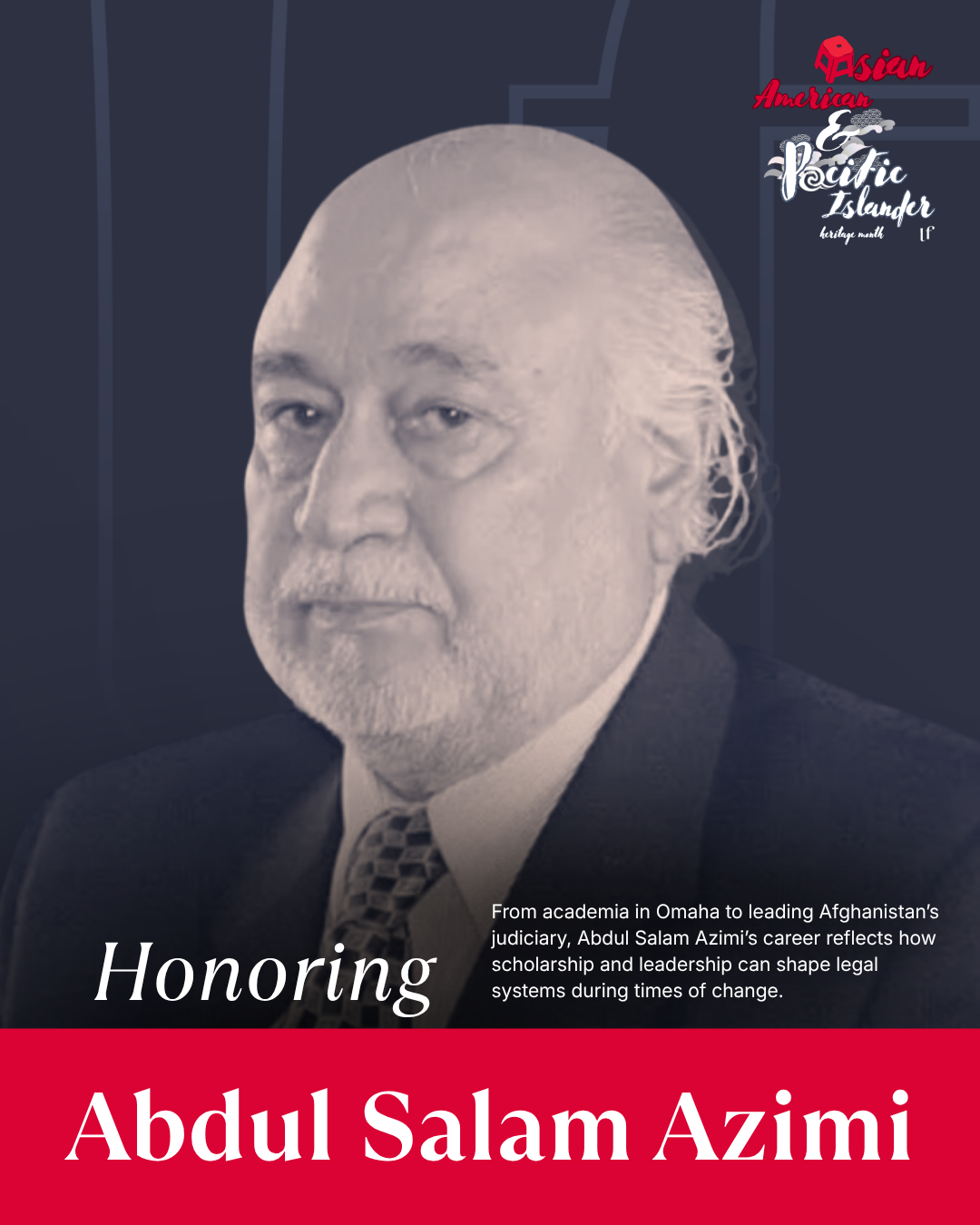
Abdul Salam Azimi’s career reflects a rare connection between academia and national leadership, moving from the classroom in Nebraska to the highest levels of Afghanistan’s legal system.
Born in 1936 in Farah province, Azimi built his early career around the study of law, studying Islamic jurisprudence at Al-Azhar University in Cairo, where he earned a master’s degree, before continuing his education at George Washington University. He later spent years in the United States teaching at the University of Nebraska Omaha. During this time, he developed a reputation as a thoughtful and measured scholar, known for bridging traditional Islamic legal frameworks with modern legal systems. His work in education was not just theoretical, it was grounded in the idea that law could evolve while still respecting cultural and religious foundations.
After the fall of the Taliban in 2001, Azimi returned to Afghanistan at a time when the country’s legal system was being rebuilt almost from the ground up. He became a legal advisor to President Hamid Karzai and played a central role in drafting Afghanistan’s 2004 Constitution, helping shape the framework for a new era of governance. His involvement placed him at the center of the most significant political transitions in the country’s recent history.
In 2006, Azimi was appointed Chief Justice of Afghanistan’s Supreme Court. In this role, he focused on strengthening the country’s judicial system during a period of instability, working to modernise court processes, improve legal education and increase public trust in the rule of law. Known for his moderate views, he advocated for interpretations of Islamic law that aligned with constitutional principles and human rights, positioning himself as a figure who could navigate both tradition and reform. His leadership came with significant challenges. Afghanistan’s legal institutions were still developing, and the pressures of political change made reform difficult. Despite this, Azimi was widely regarded as a steady and principled presence, contributing to efforts aimed at building a more structured and reliable judicial system.
Beyond his work in Afghanistan, his connection to Omaha remained an important part of his story. His time at the University of Nebraska Omaha represented more than just an academic role, it was where he shaped ideas that would later influence national policy. His career became an example of how knowledge developed within diaspora communities can play a role in rebuilding institutions back home.
Abdul Salam Azimi died in January 2026 at the age of 90. His legacy is tied to both education and reform, spanning continents and reflecting a lifetime spent working to strengthen legal systems during periods of change.
