

Grace Abbott: Nebraska’s Champion for Children and Families
Today, many of the protections and social programs that support children and families across the United States feel like a normal part of public life. But a century ago, many of those systems did not yet exist.
One of the people who helped change that was Grace Abbott.
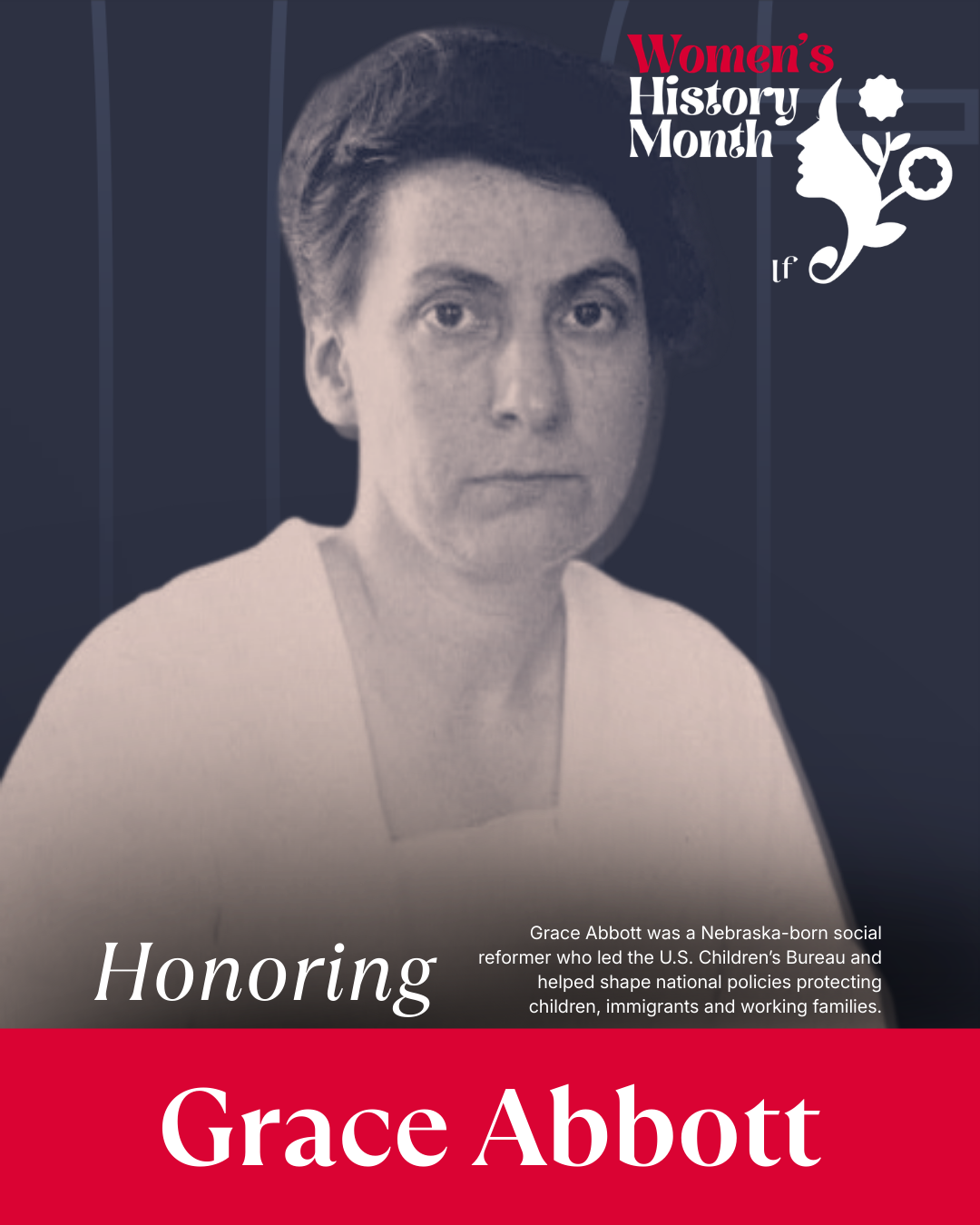
Born November 17, 1878, in Grand Island, Nebraska, Abbott grew up in a family deeply engaged in public service. Her father, Othman Ali Abbott, was a lawyer and politician who served as Nebraska’s first lieutenant governor, while her mother, Elizabeth Griffin Abbott, was a Quaker and an active supporter of abolition and women’s suffrage. Grace was also close to her older sister, Edith Abbott, who would later become a pioneering economist and social reformer in her own right. From an early age, Abbott was surrounded by conversations about justice, equality, and civic responsibility.
After graduating from Grand Island College in 1898, Abbott spent several years teaching high school in Nebraska. But her ambitions soon reached beyond the classroom. She continued her studies and eventually moved to Chicago in 1907, where she pursued graduate work at the University of Chicago, earning a master’s degree in political science in 1909. Not long after arriving in Chicago, Abbott became a resident of Hull House. The settlement house, founded by social reformer Jane Addams, became a center for progressive social reform in the early 20th century. Living and working there exposed Abbott to the difficult realities faced by immigrants and working-class families in rapidly growing American cities.
Abbott soon became deeply involved in immigrant advocacy. As director of the Immigrants’ Protective League, she investigated the exploitation of immigrant workers, published reports and articles documenting these abuses, and pushed for legislation that would better protect newly arrived families. Her work also led to the publication of her book The Immigrant and the Community in 1917, which examined the challenges immigrants faced as they tried to build new lives in the United States.
In 1921, Abbott took on what would become the most influential role of her career when she was appointed head of the U.S. Children’s Bureau. At the time, the bureau was responsible for addressing some of the most urgent issues affecting children across the country, including child labor, maternal health, and infant mortality. One of the most significant programs she helped oversee came through the Sheppard-Towner Act of 1921, which provided federal funding to support maternal and infant health services. Under Abbott’s leadership, the program helped establish more than 3,000 health clinics across 45 states, bringing medical care and health education to communities that had previously lacked access to these services. When she stepped down from the Children’s Bureau in 1934, President Franklin D. Roosevelt described her career as one of “inestimable value to the children, the mothers, and fathers of the country, as well as to the Federal and State governments.”
Abbott’s work extended beyond public health. She was also deeply involved in efforts to end child labor and improve protections for children working in dangerous industries. Abbott believed that protecting children required more than temporary assistance. As she once explained, “Children need not only food and a comfortable home, but they need above all things security.” At a time when many children still worked long hours in factories and mines, she advocated for stronger national policies that would safeguard their education, safety, and future opportunities. Her influence also reached the international stage. From 1922 to 1934, Abbott represented the United States on the League of Nations Advisory Committee on the Traffic in Women and Children, where she worked alongside other reformers to address human trafficking and exploitation.
Later in her career, Abbott contributed to the development of one of the most important social policies in American history. Working with the U.S. Secretary of Labor Frances Perkins, she helped draft the child welfare provisions that would become part of the Social Security Act of 1935, a landmark law that expanded federal support for families, workers, and vulnerable populations. After leaving federal service, Abbott returned to Chicago in 1934 and joined the University of Chicago School of Social Service Administration as a professor. There she continued teaching, writing, and advising policymakers, helping shape a new generation of social workers and public administrators.
Grace Abbott died on June 19, 1939, but her influence remains deeply embedded in the systems that protect children and families today. From immigrant protections to child labor reform and national social welfare programs, her work helped lay the foundation for policies that continue to shape American society. More than a century after she began her work, Abbott’s legacy is a reminder that lasting change often comes from people who are willing to challenge injustice and imagine a better system for those who come after them.
