

Preserving Afghanistan’s Story: The Lifelong Work of Shaista Wahab
Celebrating Asian American & Pacific Islander Heritage Month
Story by Hamza Noor
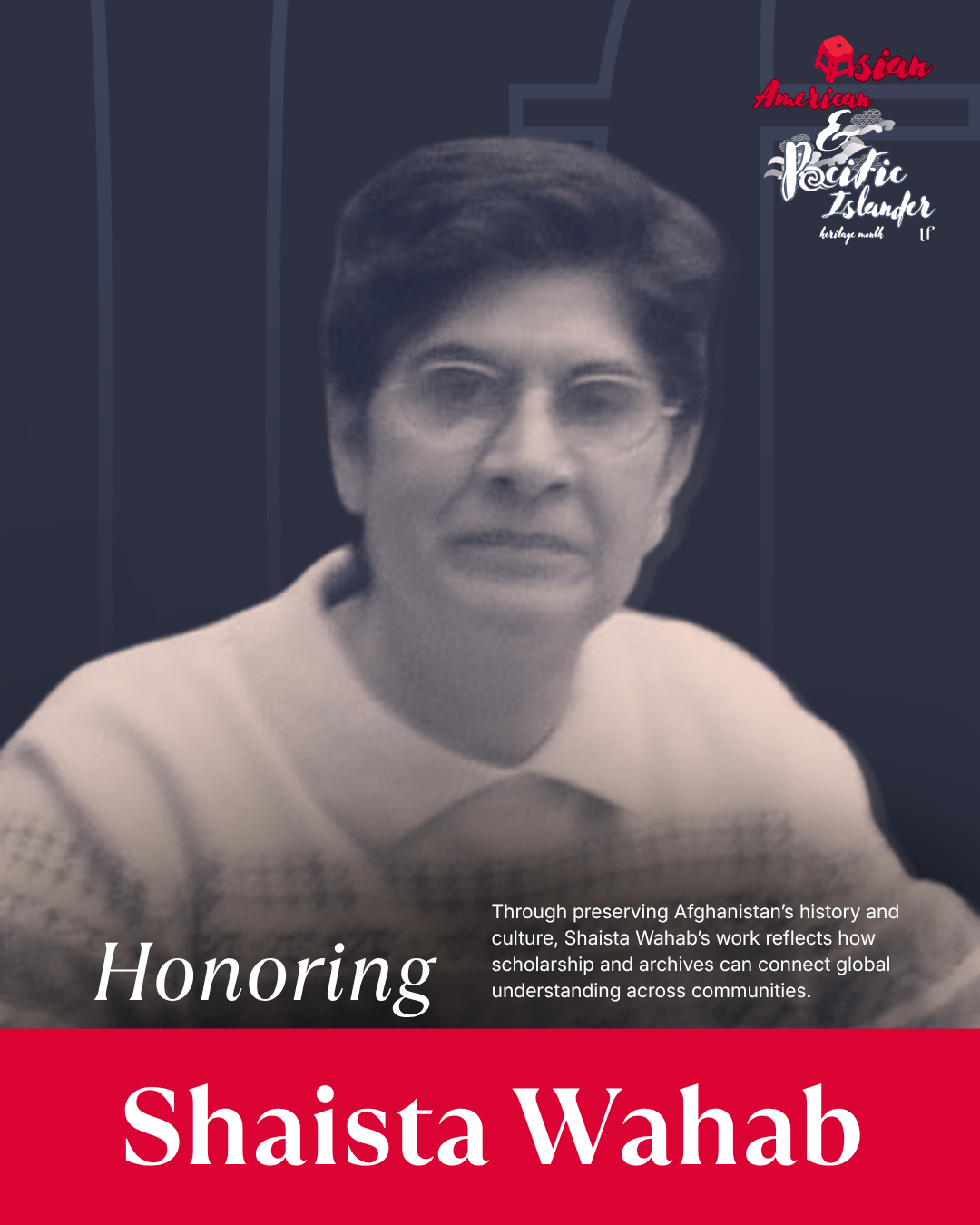
Academic institutions often become gateways to global understanding through the work of individuals who preserve and interpret knowledge across cultures. For Shaista Wahab, that work has centered on building one of the most significant collections on Afghanistan in the United States.
Wahab served at the University of Nebraska at Omaha from 1981 until her retirement in 2016, where she worked as a librarian, professor, and curator within the Criss Library Archives and Special Collections. Before relocating to Omaha, she worked with the Kabul Public Library and with international development efforts in Afghanistan, experiences that informed her later work in preserving Afghan history and culture. Over the course of her career at UNO, she became closely associated with the Arthur Paul Afghanistan Collection, helping to develop and expand it into a major academic resource. Under her leadership, the collection grew into one of the most extensive Afghanistan-focused repositories in North America, incorporating government records, rare publications, and privately donated archival materials. Her work helped position the university as an important center for scholars, journalists, and policymakers seeking a deeper understanding of Afghanistan’s history, politics, and cultural identity.
Beyond her archival work, Wahab contributed to teaching and research in Middle Eastern and South Asian studies, helping bridge cultural and academic gaps between Afghanistan and the United States. She also led oral history initiatives, documenting the lived experiences of Afghan individuals, particularly women who had lived through periods of conflict such as the Soviet invasion. Through this work, she preserved perspectives that might otherwise have been lost, adding a human dimension to academic research. Her contributions extend to writing and publishing. She co-authored A Brief History of Afghanistan, a widely used text that offers an accessible introduction to the country’s complex past for both students and general readers. She has also written language materials, including Beginner’s Dari, supporting greater access to Afghan languages and culture. Her expertise further led to involvement in public-facing projects, including contributing to the PBS documentary Afghanistan Unveiled, which brought attention to the experiences of Afghan women.
Across her career, Wahab’s work has been defined by a commitment to preserving cultural knowledge and making it accessible to wider audiences. Through her leadership in archives, education, and publishing, she has played a key role in shaping how Afghanistan is studied and understood in the United States.
